Friday, October 12, 2012
Urban Fabric Melville
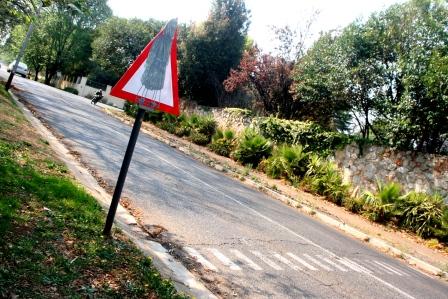
It is a comment on the state of our roads. I inserted some words to resonate with the festival title "More than just Words". I used left- over pieces of fabric donated by various people to literally weave into the fabric of the city - almost as if I am trying to mend the roads myself. With the left-over pieces of fabric I aim to address Johannesburg inhabitants who often feel powerless to do anything about the neglected state of our city - even the smallest action makes a difference and has the potential to become something more.
Melville Poetry Festival
New readers of my blog should go back to my my initial posts to understand what street art is all about and what my personal aims are. My street art interventions (to recap) are about interaction, debate, fun and even irritation on the streets of Johannesburg in an effort to comment on the city, its workings and its people.
Currently I find Johannesburg a dirty, neglected, almost abandoned city mainly due to poor services and management. I drive past the chaos that the Rea Vaya transport project (BRT) has become on Empire Rd daily and am constantly disturbed by the way in which the yellow barriers seem to migrate over the streets and pavements. I decided to relocate some barriers in a quick street art project to create awareness and promote the festival simultaneously.
The coloured pipes spouting from the tops of the barriers in a festival manner were made from off cut pipes left behind by Neotel after ripping up our pavements and leaving a general mess behind.
As always I shall clean up after myself.
Thursday, November 24, 2011
on being grafmom
Learn the text expected of me, wear the suitable costume. Get my body in the shape considered pleasant and find a mask that would not show too much of my individuality. I am a spectator of myself, constantly judging and adjusting my performance.
I believe if I can achieve this and live with it I shall find my own reality and true identity.
"Women invented a reality they could keep under control, a consciously subjective reality: they became artists."
Tuesday, October 18, 2011
Thursday, September 15, 2011
inspired: Ernest Pignon Ernest

Wall of JCE, St Andrew's Rd, Parktown:
Deborah, meaning honey bee, is known for her flaming hair. After being abused by her first husband, she became an alcoholic and ended up on the streets. Fourteen years ago she fell pregnant and turned to the Anglican Church. She was rehabilitated and has been running an Anglican Nursery School for the children of abused women for ten years.
Tuesday, September 6, 2011
moving forward
Today: 15 Sept
Vrededorp:

The third woman is an amalgamation of several women. I named her Aisha, which means alive; she who lives. She was born into a Muslim family and grew up in Vrededorp where her father owned a dressmaker and fabric shop. She qualified as a teacher. After an arranged marriage she was expected to wear a burka and was subjected to emotional abuse and a very restricted life.
Friday, September 2, 2011
Finding my feet

The second woman I portray is Mamello ( meaning patience) . She grew up in the Free State. She was raped by her uncle at the age of fifteen. She left an abuse marriage after 27 years when she was 46 years old and fled to a home for abused women in Johannesburg where we met. She has four children. Her body bears permanent scars. Today she makes and sells vetkoek to schoolchildren and workers who pass her makeshift stall every day.
Wednesday, August 31, 2011
Acid water still spewing
Saturday, July 30, 2011
inroad: (n; an instance of something/someone being reduced by something/someone else)
My first woman, although she is only a little one, is a little girl named Sinenjongo which means we have hope. She regards me as her Other grandmother and has periodically been part of my household.
She loves playing with the old white, blue eyed baby doll given to me as a child by my grandmother. The image is a metaphor for her complicated and confusing situation being tied to the white and all it implies seen against the background of both our histories.
A large part of her life is spent traveling from one home to another - from her grandmother in the Eastern Cape, to her mother's apartment, to my house. The poster was pasted as part of my first phase onto a wall facing an unoccupied, liminal area next to her mother's apartment in Hillbrow.
It lasted from 16 to 30 July.
(grafmom only uses homemade, wheatpaste glue to paste her posters - for what it is worth!)
The Deconstructed Halo
Is it the end of the long walk?

Benson, the guard, told me that "many, many" pedestrians asked after the Mandela image. I placed a much smaller image, featuring an Eastern Cape landscape and cliched vanishing road on the building. Many notions around an icon becomes idealized and the ones who do the idealizing create their own versions of the truth.
A presence through absence
Nelson Mandela: on becoming a modern icon
27 January 2011: Nelson Mandela was rushed to Milpark Hospital. Journalists went crazy and the streets around the clinic were closed to photographers. Rumours quickly started flying around that Nelson Mandela had passed away. The atmosphere was one of uncertainty and despondency.